Here's a number that should make every HR leader uncomfortable: 82% of managers in the UK are "accidental managers." They got promoted because they were good at their previous job, not because anyone prepared them to lead people. According to the Chartered Management Institute and YouGov, most of these managers received zero formal training for the role. And Gartner's data is equally sobering: 60% of new managers fail within their first 24 months.
Six out of ten. Failing. Within two years.
The reasons are predictable. New managers don't know their team well enough. They default to the management style they experienced (which was often bad). They misjudge who needs what. They give feedback the wrong way to the wrong person. And they spend their first month, sometimes their first quarter, guessing. Guessing who the strong performers are. Guessing who's about to burn out. Guessing who needs autonomy and who needs structure.
Personality data eliminates most of that guessing. Not all of it, but enough to fundamentally change the first 30 days.
The "Getting to Know You" Tax
Every new manager pays an invisible tax during their transition. It's the time spent in one-on-one meetings trying to figure out each team member. It's the missteps that happen because they didn't know someone's communication preferences. It's the weeks of observing dynamics before understanding who defers to whom and why.
In a typical scenario, it takes a new manager two to three months to feel confident they understand their team. That's two to three months of suboptimal decision-making, miscalibrated feedback, and missed opportunities to build trust. For the team, it's two to three months of wondering whether this manager "gets" them.
SHRM guidance emphasizes that conducting one-on-one meetings in the first few weeks is critical for understanding team dynamics. That's true, but it assumes the manager knows what to ask and can read between the lines of what people share. Most new managers don't. They ask surface-level questions and get surface-level answers. The deeper stuff, the "how to actually work with me" stuff, doesn't come out until there's trust. And trust takes time.
Unless you give the manager a shortcut.
The Personality Data Shortcut
Imagine starting your first day as a team's manager with the following information for every direct report:
Communication style. Does this person prefer directness or diplomacy? Do they process by talking or by writing? Do they want small talk before business, or do they prefer to get straight to the point?
Feedback preferences. Does this person respond well to public recognition, or do they find it uncomfortable? Do they want feedback delivered bluntly, or do they need it wrapped in context? Do they process feedback in real-time, or do they need a day to sit with it?
Stress signals. What does this person look like when they're overwhelmed? Do they get quiet, or do they get louder? Do they withdraw from the team, or do they overcommit? What triggers their stress, and what helps them recover?
Decision-making approach. Does this person decide quickly with limited information, or do they need comprehensive data before committing? Do they prefer to be consulted, or do they want you to just make the call?
Work rhythms. When are they most productive? Do they prefer deep focus blocks or collaborative sessions? Are they a morning person or a late-afternoon person? How do they feel about ad-hoc interruptions?
This is what a Personal User Guide contains. And for a new manager, it's the difference between spending three months building a mental model of each team member and having one on day one.
A 30-Day Playbook With Personality Data
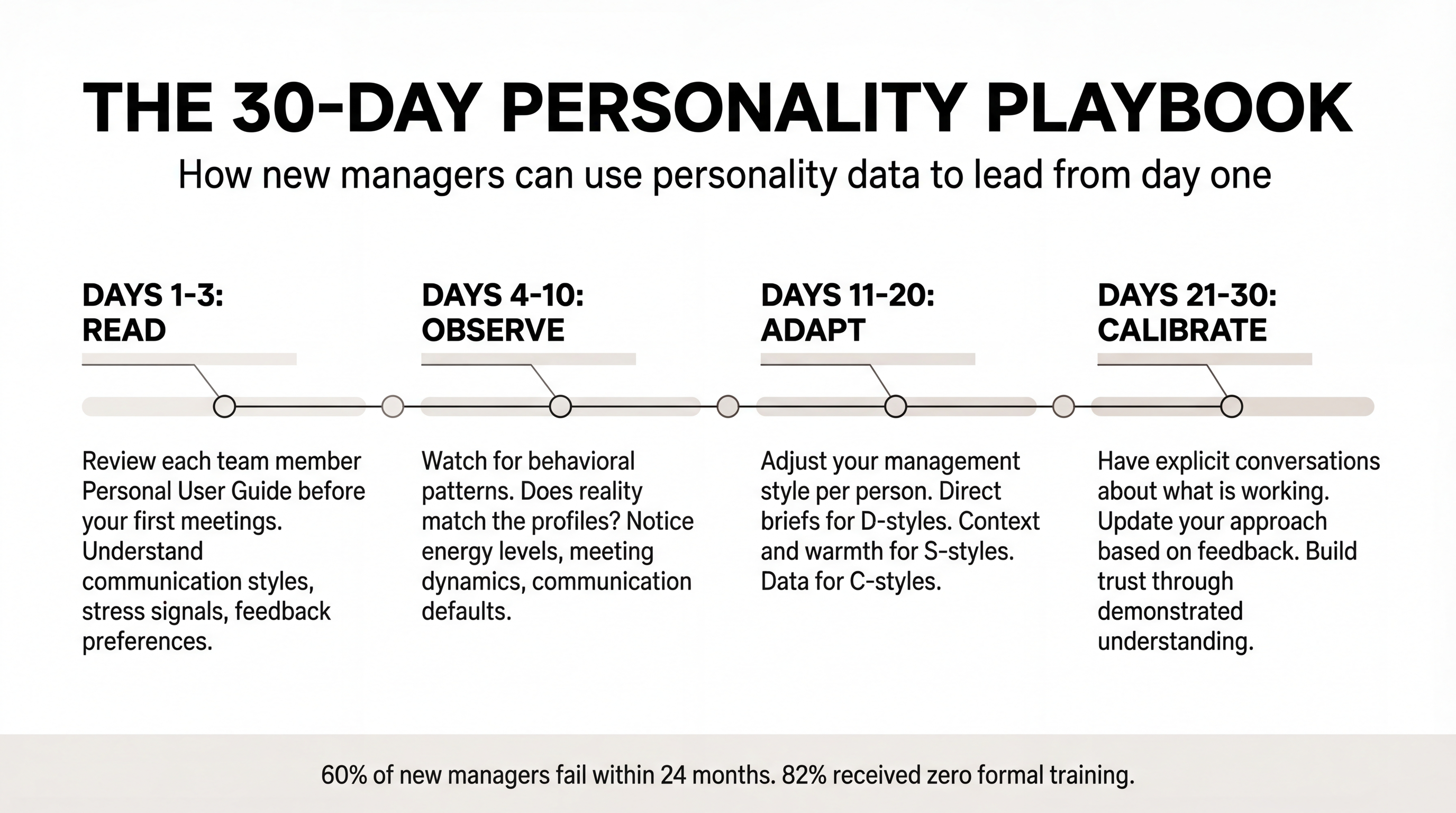
Here's what the first month looks like when you have personality data from the start.
Days 1-3: Read before you meet. Before your first round of one-on-ones, read every team member's PUG. Don't just skim. Notice the patterns. Who on this team needs autonomy? Who needs more structure? Where might communication styles clash? What feedback approaches does each person prefer? Walk into those first conversations already informed, not fishing.
Days 4-7: One-on-ones that go deeper, faster. Because you've already read their PUGs, you can skip the "tell me about yourself" portion and go straight to meaningful questions. "Your PUG mentions you prefer written feedback. Does that hold for everything, or are there situations where you'd rather talk it through?" "I noticed you process decisions slowly. How should I handle tight timelines that don't give you that space?" These questions signal that you've done your homework, and they create trust faster than any icebreaker.
Days 8-14: Observe the team dynamic through a personality lens. Watch how the team interacts in meetings. Notice who speaks first, who hangs back, who builds on others' ideas, who plays devil's advocate. Cross-reference what you observe with the personality data. Is the quiet person in meetings actually a high-S who needs to be explicitly invited to share, or are they disengaged? Is the person who dominates discussion a high-D who needs to be managed, or a high-I who just loves thinking out loud? The PUGs give you a hypothesis. Observation confirms or adjusts it.
Days 15-21: Adapt your management style. By now, you have enough information to start tailoring your approach. Your high-C direct report gets more detailed briefs. Your high-D direct report gets more autonomy and fewer check-ins. Your new team member who indicated they like structured feedback gets it via the SBI framework. Your experienced IC who prefers a coaching approach gets open-ended questions instead of directives.
Days 22-30: Establish team norms. Share your own PUG with the team. Yes, the manager should have one too. Tell them how you prefer to communicate, how you handle stress, and what kind of feedback you want from them. This models the vulnerability that builds psychological safety. Then, collaboratively define a few team norms based on the collective personality data: how the team will handle disagreements, what the expected response time on Slack is, and how decisions will be documented.
What Personality Data Can't Do
Personality data is a starting point, not a substitute for judgment. PUGs reveal behavioral tendencies and preferences, but they don't predict performance, potential, or character. A PUG can tell you that someone prefers autonomy, but it can't tell you whether they'll deliver when given it. A PUG can tell you that someone prefers direct feedback, but it can't tell you whether they'll act on it.
New managers sometimes fall into the trap of over-indexing on personality profiles. They assume that because someone is a "high-I," they're naturally suited for client-facing work, or that a "high-C" must be the right person for quality assurance. That's the same labeling mistake teams make with DISC assessments. Personality tendencies are defaults, not destinies.
Use the data to inform your approach, not to replace your own observation and relationship-building. The PUG gets you to the starting line faster. You still have to run the race.
The Multiplier Effect
When a new manager uses personality data effectively, the benefit compounds. Trust builds faster because team members feel understood from the beginning. Feedback lands better because it's delivered in the way each person prefers to receive it. Conflict is lower because the manager can anticipate friction points before they erupt. And the team's overall performance improves because the manager isn't spending three months in discovery mode.
Gartner's stat about 60% failure rates among new managers isn't inevitable. Most of those failures come from a predictable set of causes: not understanding the team, applying a one-size-fits-all management style, and making avoidable relational errors during the critical first months.
Personality data addresses all three. It gives you understanding before observation alone could provide it. It gives you a basis for tailoring your style to individual needs. And it reduces the relational errors that come from operating blind.
References
- Chartered Management Institute / YouGov. "A Better Managed Britain: Key Facts at a Glance." 2023. https://www.managers.org.uk/wp-content/uploads/2023/10/A_better_managed_Britain_The_key_facts_at_a_glance_infographic-1.pdf
- People Management. "Accidental managers without proper leadership training contributing to almost one in three workers walking out." 2023. https://www.peoplemanagement.co.uk/article/1844443/accidental-managers-without-proper-leadership-training-contributing-almost-one-three-workers-walking-out-research-finds
- Wharton Executive Education. "Managing to Fail? Why New Leaders Need Training." 2024. https://executiveeducation.wharton.upenn.edu/thought-leadership/wharton-at-work/2024/09/new-leaders-need-training/
- SHRM. "Viewpoint: Your First 90 Days as a New Manager." https://www.shrm.org/topics-tools/news/organizational-employee-development/viewpoint-first-90-days-new-manager
- Gallup. "Managers Account for 70% of Variance in Employee Engagement." https://news.gallup.com/businessjournal/182792/managers-account-variance-employee-engagement.aspx