The man who created the theoretical foundation for DISC also invented the lie detector and co-created Wonder Woman. That's not a trivia aside. It tells you something important about William Moulton Marston: he was fascinated by human behavior, power dynamics, and truth-telling. When he published "Emotions of Normal People" in 1928, he wasn't building a hiring tool. He was trying to map how ordinary people respond to their environment. Almost a century later, over a million people take DISC assessments every year. And most of them are using it in ways Marston never intended.
What DISC Actually Measures (and What It Doesn't)
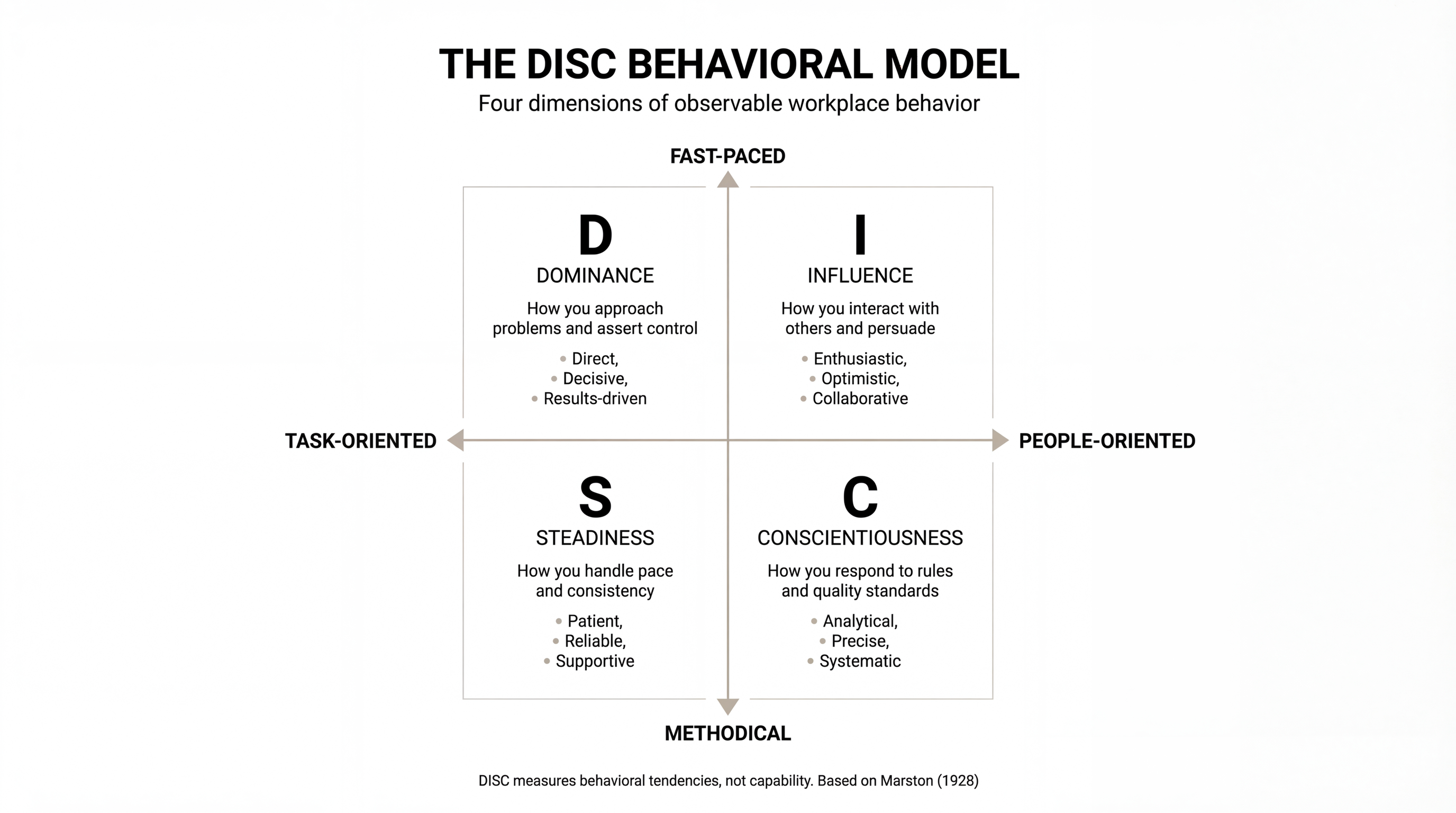
DISC profiles people across four behavioral dimensions: Dominance (how you approach problems and assert control), Influence (how you interact with others and express enthusiasm), Steadiness (how you handle pace and consistency), and Conscientiousness (how you respond to rules, procedures, and quality standards).
That's it. Four dimensions of observable behavior. DISC tells you how someone tends to act, communicate, and respond to their environment. It does not measure intelligence, aptitude, values, emotional depth, or job-specific competence.
This distinction matters because the most common misuse of DISC is treating it as a predictive tool. Psychologist Wendell Williams has argued that any personality assessment used in hiring needs evidence for reliability and criterion validity against job-performance criteria. The EEOC and OPM make the same practical point: tests used for employment decisions need job-related validation. DISC, by design, doesn't aim for that. A Scandinavian Journal of Psychology validation study of DISCUS found that its dimensions represented combinations of Big Five traits rather than independent traits.
None of this means DISC is useless. It means DISC is being asked to do a job it was never built for.
Three Ways Teams Get DISC Wrong
1. Using DISC for hiring decisions.
This is the biggest and most consequential mistake. When a hiring manager sees that a candidate profiles as a "high-S" and concludes they're not assertive enough for a leadership role, they've just made a decision based on behavioral tendency, not capability. Behavioral style is not the same as behavioral range. A high-S person can absolutely lead with authority; they just default to a different approach. Screening candidates by DISC profile is like rejecting a chef because they prefer Italian food. It tells you about preference, not skill.
2. Treating DISC as a fixed identity.
"I'm a D, so I can't help being blunt." Sound familiar? When DISC becomes an excuse rather than a tool, it actively harms team dynamics. People are not their profiles. DISC measures behavioral tendencies in a specific context at a specific time. Those tendencies shift with stress, environment, and experience. Using your DISC type as a permanent label is like insisting you're "not a morning person" after one bad night's sleep.
3. Stopping at the label.
The most common version of this: a team does a DISC workshop, everyone gets their color or letter, there are some laughs about who's a "high-I," and then the results go into a drawer. Without a framework for applying the insights to daily interactions, DISC becomes expensive entertainment. The assessment itself is only the starting point. The value comes from what you do with it afterward.
What DISC Is Actually Good At
When used correctly, DISC excels at one thing: creating a shared language for how people communicate and collaborate. And that's not a small thing.
Consider a product team with a high-D project lead and a high-S designer. The lead communicates in bullet points and expects fast turnarounds. The designer needs time to process, prefers context over directives, and interprets terse messages as hostility. Without a shared language, this becomes a personality conflict. With DISC awareness, it becomes a solvable translation problem.
DISC gives teams a vocabulary for these differences. Instead of "She's cold and demanding" or "He's slow and resistant," the conversation becomes "She's a high-D who leads with directness, and he's a high-S who needs processing time." That reframe alone can defuse months of accumulated friction.
Everything DiSC, one of the most widely used assessment publishers, reports a 90% accuracy rating using their computer-adaptive version. Whether you agree with that self-reported number or not, the practical reality is that millions of teams find DISC useful. Not because the science is bulletproof, but because having any shared framework for understanding behavioral differences is better than having none.
The Right Way to Use DISC in Your Team
If you're going to use DISC (and there are good reasons to), here's how to get actual value from it:
Use it for awareness, not for judgment. The goal is to help people understand their default behavioral patterns and recognize the patterns of others. It's a mirror, not a verdict.
Pair it with other frameworks. DISC captures behavior, but behavior is only one layer. Layering DISC with MBTI and the Enneagram gives you a much richer picture: how someone acts (DISC), how they think (MBTI), and what drives them (Enneagram). No single assessment tells the whole story.
Apply it to specific scenarios. Don't just share profiles. Use them to prepare for project kickoffs, structure feedback conversations, and design team norms. When a high-C team member asks for more detail in briefs, that's not them being difficult. That's their behavioral need for accuracy and completeness. Meeting that need costs you a paragraph. Ignoring it costs you rework.
Revisit regularly. Behavioral tendencies shift with role changes, life events, and team dynamics. A DISC result from two years ago may not reflect how someone operates today. Treat it as a snapshot, not a mugshot.
Never use it in hiring. Full stop. If you're screening candidates based on DISC profiles, you're introducing bias without predictive validity. There are purpose-built assessments for hiring. DISC isn't one of them.
Beyond DISC: Where the Real Value Lives
The limitation of any single personality framework is that it reduces a complex person to a few dimensions. DISC gives you behavioral tendencies. That's useful. But it doesn't tell you how someone handles stress, what motivates them at a deep level, how they prefer to receive feedback, or what they need from their manager.
This is where tools like Personal User Guides come in. A PUG takes the insights from DISC (and other assessments) and translates them into practical, actionable guidance. Instead of "high-D," it says "When you need a decision from me, give me two options and a deadline. I'll move fast." Instead of "high-S," it says "I need 24 hours to sit with feedback before discussing it. Please don't read my silence as disagreement."
The science behind DISC is real, even if it's sometimes overstated. The behavioral model works. The four dimensions map to genuine patterns in how people interact. But the science is only as good as the application. Use DISC as a starting point for richer understanding, not as the final word on who someone is. And for the love of Marston, stop using it to screen resumes.
References
- Marston, William Moulton. Emotions of Normal People. Kegan Paul, Trench, Trubner & Co., 1928. https://openlibrary.org/books/OL13968575M/Emotions_of_normal_people
- Martinussen, Monica, Astrid M. Richardsen, and Helge W. Vårum. "Validation of an ipsative personality measure (DISCUS)." Scandinavian Journal of Psychology, 2001. https://pubmed.ncbi.nlm.nih.gov/11771810/
- Williams, Wendell. "Personality Tests for Employee Selection." Association for Research in Personality newsletter, 2013. https://www.personality-arp.org/html/newsletter07/job_performance.html
- U.S. Equal Employment Opportunity Commission. "Employment Tests and Selection Procedures." https://www.eeoc.gov/laws/guidance/employment-tests-and-selection-procedures
- Everything DiSC. "The Science Behind Everything DiSC." https://www.everythingdisc.com/the-science-behind-disc