Somewhere around 2016, "psychological safety" went from an academic concept to a LinkedIn buzzword. Every leadership consultant started dropping it into keynotes. Every HR deck featured it in a pastel-colored slide. Every company offsite included a session on "creating safe spaces for dialogue." And yet, most teams are no safer than they were before the term went mainstream.
The problem isn't the concept. Psychological safety is one of the most well-researched, practically useful ideas in organizational psychology. The problem is what happened to it on the way from the research lab to the corporate workshop. It got flattened. Diluted. Turned into a feel-good platitude that means everything and nothing at the same time. So let's strip away the posters and talk about what psychological safety actually is, what it isn't, and how to build it without sounding like a corporate wellness brochure.
What It Actually Means (And What It Doesn't)
Amy Edmondson, the Harvard Business School professor who coined the term in 1999, defined team psychological safety as "a shared belief that the team is safe for interpersonal risk-taking." That's a precise definition. Read it again. It's about interpersonal risk. The risk of looking stupid. The risk of admitting a mistake. The risk of challenging someone senior. The risk of saying "I don't understand" in a room where everyone else seems to get it.
Psychological safety is not about being nice. It's not about avoiding conflict. It's not about making everyone comfortable all the time. In fact, psychologically safe teams often have more conflict than unsafe ones, because people actually voice their disagreements instead of smiling through them.
Here's a distinction that trips up a lot of leaders: psychological safety doesn't mean people feel good. It means people feel safe enough to say things that might make others feel uncomfortable. That's a very different thing. Safe teams disagree. They push back. They call out problems early. What they don't do is punish people for doing any of that.
The Edmondson Paradox
One of the most counterintuitive findings in Edmondson's early research came from hospitals. She expected to find that the best-performing medical units would report fewer errors. Instead, she found the opposite: units with higher psychological safety reported more errors. Not because they made more mistakes, but because the staff felt safe enough to report them.
Think about what that means for your team. The department with the cleanest error log might not be the one making the fewest mistakes. It might be the one where people are most afraid to admit them. The team that never pushes back in meetings might not be aligned. They might be self-censoring. The colleague who always says "sounds good" might not agree at all. They've just learned that disagreement has a cost.
Google's Project Aristotle confirmed this at scale. Between 2012 and 2014, Google studied hundreds of internal teams to find what made some effective and others dysfunctional. They tested for everything: team composition, individual performance, work styles, tenure. The single most important factor? Psychological safety.
Why the Buzzword Version Fails
So if the research is this clear, why aren't more teams psychologically safe? Because most attempts to build it confuse the signal with the noise.
The poster problem. Putting "It's okay to fail" on the wall doesn't make it okay to fail. If someone raises a concern and gets shut down in the next meeting, the poster is worse than useless. It's actively dishonest. People don't read posters. They read behavior. Specifically, they read how leaders respond to bad news, mistakes, and dissenting opinions.
The one-workshop-and-done approach. A two-hour session on psychological safety might increase awareness, but it doesn't change team norms. Norms are built through repeated interactions over weeks and months. A workshop plants a seed. Without consistent follow-through, that seed never grows.
The niceness trap. Some teams interpret psychological safety as "we should never make anyone uncomfortable." This leads to a different dysfunction: artificial harmony. People agree to avoid tension. Feedback gets so softened that it loses its meaning. Real issues get buried under politeness. Lencioni called this the second dysfunction of a team: fear of conflict. Ironically, the attempt to create safety produces a team that's unsafe for honest conversation.
How to Actually Build It
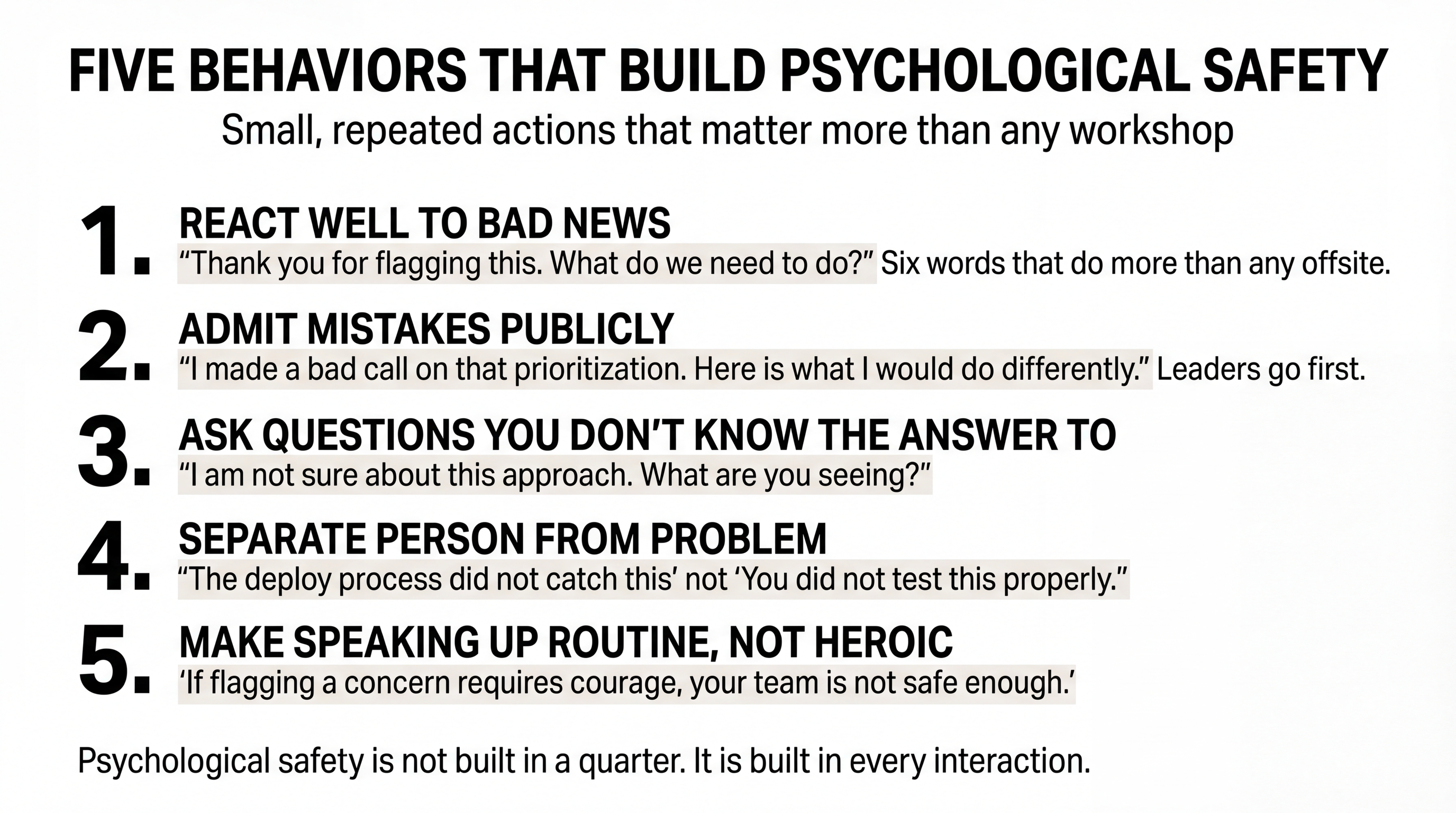
Forget the frameworks for a moment. Psychological safety is built through small, repeated actions. It's not a program you implement. It's a set of behaviors you practice until they become the team default. Here's what those behaviors look like in practice.
React well to bad news. This is the single highest-leverage behavior a leader can adopt. When someone tells you a project is behind schedule, a client is unhappy, or a feature has a critical bug, your first response sets the tone for every future disclosure. If you get frustrated, tense, or immediately start asking "how did this happen," you've just taught the team that reporting problems comes with a cost. The alternative: "Thank you for flagging this. What do we need to do?" Six words that do more for safety than any offsite.
Admit your own mistakes publicly. Edmondson's research emphasizes that leaders need to go first. When a VP says "I made a bad call on that prioritization last sprint, and here's what I'd do differently," it gives everyone else permission to be similarly honest. This isn't performative vulnerability. It's modeling the behavior you want to see.
Ask questions you don't know the answer to. Leaders who always have the answer create teams that stop offering alternatives. Leaders who say "I'm not sure about this approach; what are you seeing?" create teams that think critically. The question is more powerful than the answer, because the question signals that other perspectives are genuinely wanted.
Separate the person from the problem. When something goes wrong, focus the conversation on the system, process, or decision, not on the individual. "The deploy process didn't catch this regression" is a safer conversation starter than "You didn't test this properly." Both address the same issue. One builds safety; the other destroys it.
Make speaking up easy, not heroic. If flagging a concern requires courage, your team isn't safe enough. Create structures that normalize it: regular retrospectives, anonymous concern channels, pre-mortems before big launches, and explicitly asking "What could go wrong?" in planning sessions. The goal is to make risk-flagging boring and routine, not brave and exceptional.
The Personality Connection
Here's something the psychological safety literature often overlooks: safety feels different for different people. A direct, assertive team member might feel perfectly safe pushing back in a meeting. A quieter, more reflective colleague might find the same meeting format impossible to speak up in, not because the team is unsafe, but because the structure doesn't match their communication style.
Understanding personality differences accelerates psychological safety because it removes accidental violations. If you know that a team member processes feedback slowly and needs time before responding, you won't put them on the spot in a group setting. If you know someone's stress response is to withdraw, you won't interpret their silence as disengagement.
Personal User Guides make this practical. When every team member's communication preferences and stress signals are documented and shared, the team can adapt its interactions to meet individual needs. That adaptation is psychological safety in action. It's the team saying "we've taken the time to understand how you work, and we're going to respect it."
Measuring It Without Killing It
Edmondson developed a simple 7-question survey to measure psychological safety in teams. It asks people to rate statements like "If you make a mistake on this team, it is often held against you" and "Members of this team are able to bring up problems and tough issues." It's short, anonymous, and actionable.
But be careful with measurement. The moment psychological safety becomes a metric that managers are evaluated on, it risks becoming performative. People will game the survey. Managers will optimize for the score rather than the behavior. The metric becomes the target, and the target becomes meaningless.
Measure it periodically. Use it to identify teams that need support. But don't turn it into a KPI. The best indicator of psychological safety is still the simplest one: do people on this team regularly share bad news, disagree with each other, and ask for help? If yes, you're in good shape. If those behaviors are rare, no survey score will tell you otherwise.
The Long Game
Psychological safety isn't built in a quarter. It's built over months and years of consistent behavior. One bad reaction to a mistake can erase months of progress. One leader who punishes dissent can undo an entire team's sense of safety. That fragility is both the challenge and the point. Safety requires ongoing investment because it reflects the ongoing quality of relationships on the team.
The teams that get this right don't talk about psychological safety much. They just practice it. They have honest retros. They admit when they don't know something. They disagree productively. They adapt to each other's needs. And when someone makes a mistake, the first response is "How do we fix it?" not "Whose fault is it?"
References
- Edmondson, Amy. The Fearless Organization: Creating Psychological Safety in the Workplace. Wiley, 2018. https://www.wiley.com/en-us/The+Fearless+Organization%3A+Creating+Psychological+Safety+in+the+Workplace+for+Learning%2C+Innovation%2C+and+Growth-p-9781119477242
- Edmondson, Amy. "Psychological Safety and Learning Behavior in Work Teams." Administrative Science Quarterly, 1999. https://dash.harvard.edu/entities/publication/13a7b031-0fdd-45ec-a7e0-2b80e2bc679f
- Google. "Understand team effectiveness." re:Work. https://rework.withgoogle.com/en/guides/understanding-team-effectiveness
- Lencioni, Patrick. The Five Dysfunctions of a Team. Jossey-Bass, 2002. https://www.wiley.com/en-us/The+Five+Dysfunctions+of+a+Team%3A+A+Leadership+Fable%2C+20th+Anniversary+Edition-p-9781119600459
- Delizonna, Laura. "High-Performing Teams Need Psychological Safety. Here's How to Create It." Harvard Business Review, 2017. https://hbr.org/2017/08/high-performing-teams-need-psychological-safety-heres-how-to-create-it