Last month, a manager I work with gave the same piece of feedback to two different engineers on her team. The message was identical: their code reviews were taking too long and creating a bottleneck for the rest of the team. She delivered it the same way to both: directly, in their one-on-one, with specific examples.
One engineer said "Got it, I'll fix that this week" and immediately adjusted their process. The other went quiet for three days, started second-guessing every review, and eventually brought it up in their next meeting as something that had been "really weighing on them."
Same feedback. Same delivery. Completely different outcomes. The manager wasn't wrong to give the feedback. She was wrong to assume that one delivery method works for everyone. And that assumption is so common that most of us don't even recognize we're making it.
The Default Delivery Problem
Most people give feedback the way they prefer to receive it. If you value directness, you deliver feedback directly. If you prefer context and gentleness, you wrap feedback in cushioning. This feels natural, even empathetic. But it's actually a form of projection. You're optimizing for your own comfort, not the recipient's needs.
The research backs this up. The Center for Creative Leadership developed the SBI model (Situation-Behavior-Impact) specifically because unstructured feedback creates anxiety for the giver and defensiveness for the receiver. SBI gives you a framework: describe the Situation, the specific Behavior you observed, and the Impact it had. It's clean, objective, and behavior-focused rather than character-focused.
But SBI is the structure. The delivery is a separate problem. You can use a perfect SBI format and still miss the mark if the way you present it doesn't match how the other person processes feedback.
Four People, Four Feedback Styles
Let's use a concrete example. You need to tell someone that their presentations to stakeholders are too detailed and they're losing the audience. Same message, four different approaches based on DISC behavioral style.
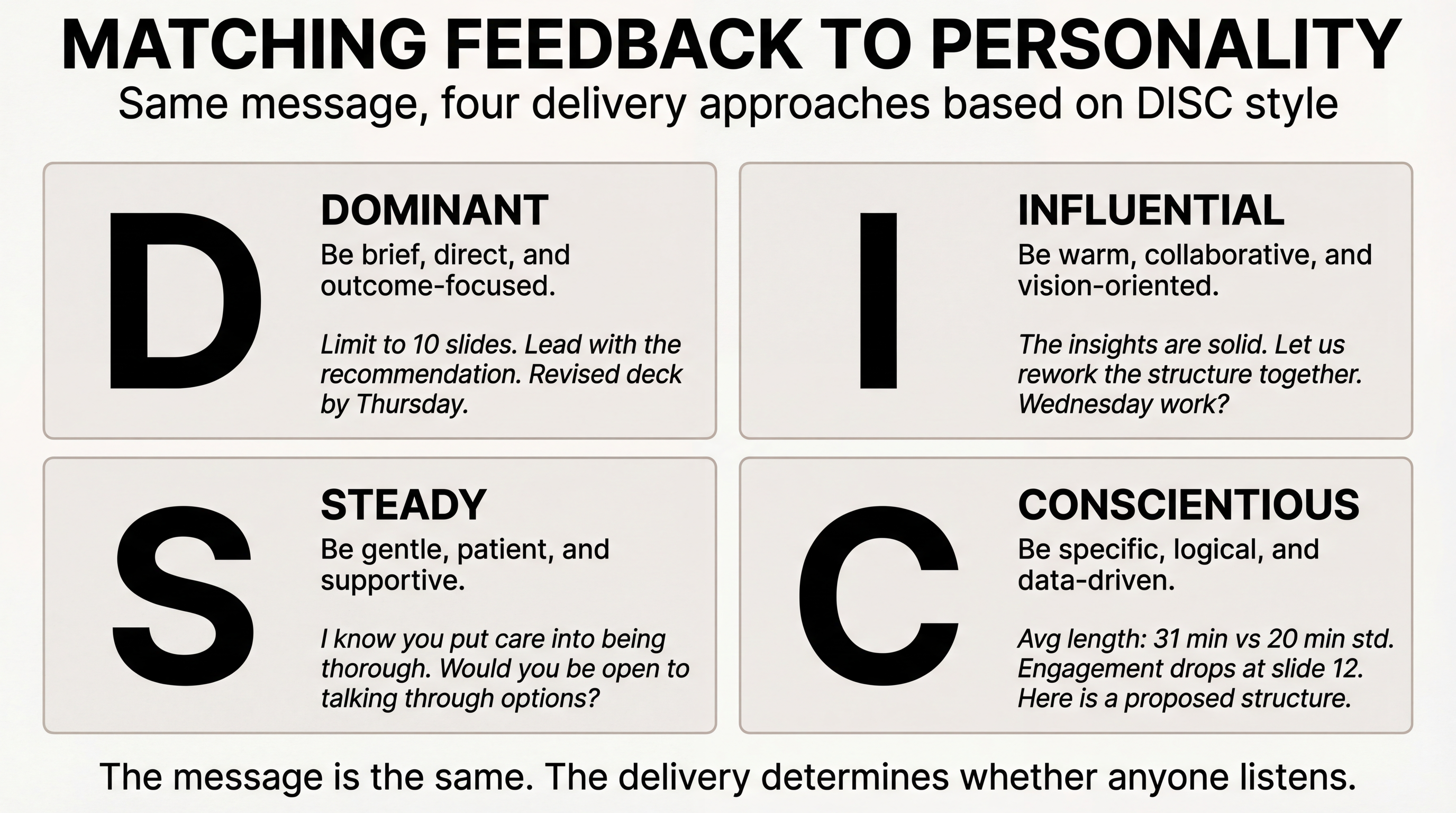
For the Dominant (D) style: Be brief, direct, and outcome-focused.
"Your last two stakeholder presentations ran 20 minutes over because of excessive detail. The VPs started checking their phones by slide 15. For the next one, limit it to 10 slides max. Lead with the recommendation, keep the supporting data in an appendix. Can you have a revised deck to me by Thursday?"
Why this works: D-styles respect efficiency. They want the problem stated clearly and the expectation made explicit. They don't need preamble, reassurance, or a lengthy explanation of why this matters. Giving them a clear directive and a deadline feels respectful, not harsh.
For the Influential (I) style: Be warm, collaborative, and vision-oriented.
"I've noticed that your stakeholder presentations have so much great detail that the audience can't absorb it all in the time we have. The insights are solid; the challenge is packaging. What if we spent 20 minutes together reworking the structure? I think we can make it land even better with the VPs. Would Wednesday work?"
Why this works: I-styles are motivated by relationships and recognition. Leading with what's working ("the insights are solid") before addressing the issue shows you see the effort behind the work. Framing the fix as a collaboration rather than a correction keeps their energy positive.
For the Steady (S) style: Be gentle, patient, and supportive.
"I wanted to check in about the stakeholder presentations. I've noticed they've been running long, and I think the audience is having trouble absorbing everything. I know you put a lot of care into being thorough, and that's genuinely valuable. I think a smaller adjustment could make a big difference. Would you be open to talking through some options for streamlining the next one? No rush. Let's find a time this week."
Why this works: S-styles need to feel safe before they can hear feedback. Rushing or being too blunt makes them shut down. Acknowledging their intention (thoroughness = care) before suggesting a change shows empathy. Giving them time to process ("let's find a time this week") rather than expecting an immediate response respects their pace.
For the Conscientious (C) style: Be specific, logical, and data-driven.
"I've reviewed the last three stakeholder presentations, and I've noticed a pattern. Average length: 35 minutes against a 20-minute slot. Audience engagement drops around slide 12 based on the questions we receive afterward. I'd like to propose a structure: executive summary on slide 1, three key findings on slides 2-4, recommendation on slide 5, and all supporting data in a separate appendix they can review asynchronously. Can you adapt the next presentation using this structure and send me a draft?"
Why this works: C-styles trust data over opinion. Showing that you've actually analyzed the problem (three presentations, specific slide numbers, engagement pattern) makes the feedback feel objective rather than arbitrary. Providing a detailed structural alternative gives them a clear framework to follow, which they find reassuring rather than constraining.
Why This Matters More Than You Think
These four approaches deliver the exact same message. The presentations are too long. Trim them. But the emotional experience of receiving the feedback is wildly different depending on the delivery.
The D-style would find the S-style approach patronizing. The S-style would find the D-style approach bruising. The I-style would feel disconnected from the C-style's data dump. The C-style would find the I-style's approach frustratingly vague.
When feedback doesn't land, the most common conclusion is that the recipient "can't handle feedback" or is "too sensitive." But in most cases, the problem isn't the recipient's resilience. It's the sender's delivery. Understanding personality differences turns a character judgment into a practical adjustment.
Building a Feedback Culture That Scales
Tailored feedback sounds great in theory, but how do you scale it across a team of 15? Or 50? You can't memorize every person's DISC profile and communication preferences.
This is where systems help. When every team member has a Personal User Guide that includes their feedback preferences, any manager or peer can check it before a critical conversation. It takes 60 seconds to review someone's PUG before a one-on-one. That 60 seconds can be the difference between feedback that gets acted on and feedback that creates a week of anxiety.
Some practical steps for building a personality-aware feedback culture:
Include feedback preferences in PUGs. Ask every team member to document how they prefer to receive feedback. Written or verbal? Private or in a group? Direct or contextual? Immediately or with advance warning? This isn't about coddling people. It's about efficiency. Feedback delivered in the preferred format gets processed and acted on faster.
Train managers on DISC feedback patterns. You don't need to become a personality assessment expert. You need to know four general patterns: D-styles want it fast and direct, I-styles want it positive and collaborative, S-styles want it gentle and patient, C-styles want it specific and logical. That's the foundation. The PUGs fill in the details.
Normalize asking "How do you want me to deliver this?" For sensitive feedback, there's nothing wrong with asking the person how they'd like to receive it. "I have some feedback about the project timeline. Would you prefer I share it now, or would you like a heads-up and we can discuss it tomorrow?" This question itself builds psychological safety because it demonstrates respect for the other person's experience.
Separate the SBI structure from the delivery style. SBI is your content framework. Personality awareness is your delivery framework. Use both. Structure the feedback using Situation-Behavior-Impact so it stays objective and specific. Then deliver it using the style that matches the recipient's personality. Structure plus style equals feedback that actually changes behavior.
The Feedback Loop Nobody Talks About
Here's the part that gets overlooked: feedback delivery also affects feedback seeking. When someone receives feedback in a way that feels safe and respectful, they're more likely to ask for feedback in the future. When feedback feels like an attack, even if the content is valid, the person learns to avoid it. They stop asking. They stop sharing work-in-progress. They wait until things are "perfect" before showing anyone, which means problems go unaddressed longer and course corrections happen later.
The cost of poor feedback delivery isn't just one bruised interaction. It's a gradual erosion of openness. Over months, a team where feedback consistently lands poorly becomes a team where people stop sharing vulnerabilities, stop admitting mistakes, and stop seeking help. The surface looks functional. Underneath, learning has stalled.
Matching feedback to personality isn't about making people comfortable. It's about keeping the learning loop open. Because a team that can give and receive honest feedback, in a way that each person can actually hear, is a team that gets better every week. And a team that can't is a team that's slowly calcifying, one misdelivered conversation at a time.
References
- Center for Creative Leadership. "About Our Research." https://www.ccl.org/about-us/research/
- Zenger, Jack, and Joseph Folkman. "The Ideal Praise-to-Criticism Ratio." Harvard Business Review, 2013. https://hbr.org/2013/03/the-ideal-praise-to-criticism
- Everything DiSC. "The Science Behind Everything DiSC." https://www.everythingdisc.com/the-science-behind-disc
- Stone, Douglas, and Sheila Heen. Thanks for the Feedback. Penguin Books, 2014. https://www.penguinrandomhouse.com/books/313485/thanks-for-the-feedback-by-douglas-stone-and-sheila-heen/
- Edmondson, Amy. The Fearless Organization. Wiley, 2018. https://www.wiley.com/en-us/The+Fearless+Organization%3A+Creating+Psychological+Safety+in+the+Workplace+for+Learning%2C+Innovation%2C+and+Growth-p-9781119477242