A designer on my team recently described himself as an ENFP, a high-I/S on DISC, and a Type 7 on the Enneagram. When I asked him what that actually meant for how he works, he laughed and said, "I have a lot of letters and numbers, but I still don't know why I procrastinate on documentation."
He's not alone. Personality assessments are more popular than ever. MBTI has been around since the 1940s. DISC traces back to the 1920s. The Enneagram has roots in multiple philosophical traditions and gained mainstream workplace traction in the last decade. Millions of people have taken one, two, or all three. And yet most of them walk away with labels rather than understanding.
The problem isn't the frameworks. Each one captures something real about human behavior. The problem is that most teams use them in isolation, as if any single lens could capture the full picture of a complex person. It can't. But when you layer them intentionally, something genuinely useful emerges.
Three Lenses on the Same Person
Each framework measures a fundamentally different dimension of personality. Understanding what each one captures, and what it misses, is the key to using them together.
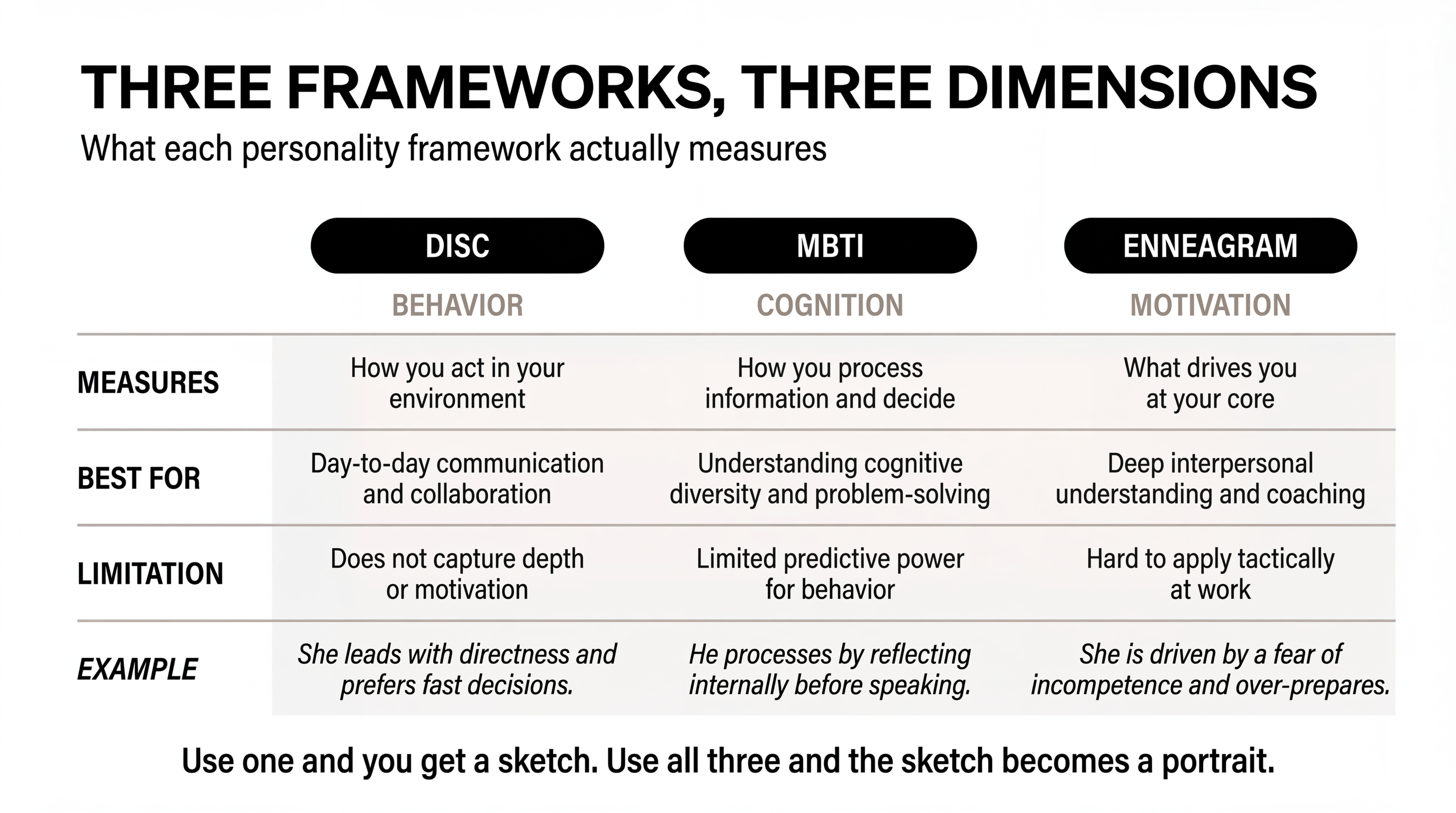
DISC measures behavior. How do you tend to act in your environment? Are you assertive or accommodating? Do you prefer fast action or careful analysis? Do you gravitate toward people or toward tasks? DISC is practical and observable. It's the "what you see" layer. A DISC profile tells you that someone communicates directly, prefers structured processes, and gets impatient with small talk. What it doesn't tell you is why.
MBTI measures cognition. How do you take in information and make decisions? Are you energized by external interaction (Extroversion) or internal reflection (Introversion)? Do you prefer concrete data (Sensing) or abstract patterns (Intuition)? Do you decide based on logic (Thinking) or values (Feeling)? MBTI captures how someone's mind works, their default mode of processing. But cognitive preference doesn't always predict behavior. An INTJ might test as a high-D on DISC if their role requires it, even though their natural state is reflective and strategic.
Enneagram measures motivation. What drives you at your core? What are you afraid of? What do you desire most deeply? The Enneagram maps nine fundamental personality patterns, each defined by a core fear (failure, abandonment, insignificance, etc.) and a core desire (competence, security, autonomy, etc.). This is the "why behind the what" layer. It explains why someone who behaves assertively on the outside might be driven by a deep fear of being controlled (Type 8), or why someone who seems agreeable is actually motivated by a need to be needed (Type 2).
Where Each Framework Shines (And Where It Falls Short)
DISC is best for day-to-day workplace interactions. It's easy to understand, quick to apply, and directly relevant to communication, collaboration, and feedback delivery. Its simplicity is its strength. Four dimensions. Minimal jargon. Immediately actionable. But that simplicity is also its limitation. DISC doesn't capture depth. Two people can have identical DISC profiles and be profoundly different people because their motivations, fears, and cognitive styles differ entirely.
MBTI is best for understanding how people think and process information. It's particularly useful for structuring teams around complementary cognitive styles, for understanding why someone approaches problem-solving differently, and for identifying potential friction between people who process information in opposing ways. Its weakness is practical application. Knowing someone is an INFP is interesting. Knowing what to do about it in a project kickoff is harder. MBTI is also criticized for limited predictive power regarding actual job performance.
Enneagram is best for deep interpersonal understanding and personal growth. It's powerful for coaching, for understanding why someone reacts strongly to certain situations, and for predicting behavior under stress (each type has a predictable stress pattern). Its workplace weakness is that it's harder to apply tactically. You can build a meeting agenda around DISC styles. You can't easily build one around Enneagram core fears. The Enneagram is a depth tool, not a speed tool.
MBTI assessments typically run $15-40 per person. DISC ranges from $24-100 depending on the provider. Enneagram tends to be the most affordable at $12-24. But cost alone shouldn't drive the choice.
The Layering Strategy
So how do you actually combine them without overwhelming your team with personality data? Here's a practical approach.
Start with DISC for team communication. DISC gives you immediate, actionable value. Within an hour of reading DISC profiles, a team can adjust how they run meetings, give feedback, and communicate on Slack. It's the broadest, most accessible starting point. If your team has never done any personality work, start here.
Add MBTI for cognitive diversity. Once the team is comfortable with DISC, MBTI adds the cognitive layer. This is especially valuable for teams that solve complex problems, design products, or make strategic decisions. Understanding that half your team prefers Sensing (concrete, practical) and half prefers Intuition (abstract, pattern-based) explains why brainstorming sessions feel productive for some and frustrating for others. You can design processes that give both styles room to contribute.
Introduce Enneagram for depth and coaching. The Enneagram is best introduced in a context of trust and psychological safety. It's more personal than DISC or MBTI because it touches on fears, desires, and emotional patterns. Used well, it deepens empathy between team members. Used poorly (or too early), it can feel invasive. Save this for teams that already have a foundation of trust and are ready for deeper self-understanding.
The Integration Problem
The challenge with multiple frameworks isn't learning them. It's integrating them. When someone has a DISC profile, an MBTI type, and an Enneagram number, that's a lot of information for their colleagues to hold in their heads. And most people won't hold it. They'll remember one label and forget the rest.
This is where synthesis matters more than stacking. The goal isn't to give every team member three separate profiles. It's to translate those profiles into one practical, integrated document. A Personal User Guide does exactly this. Instead of "I'm a high-D, ENTJ, Type 8," a PUG says:
"I make decisions quickly and prefer you to bring me options rather than open-ended questions. I process information by debating it, so don't mistake my pushback for disagreement. I'm at my worst when I feel like someone is trying to control the outcome without being transparent. The best way to give me feedback is directly and with specifics."
That paragraph draws on all three frameworks without mentioning any of them. It's not about the labels. It's about the practical output. And that output is what teammates actually use in their daily interactions.
Common Mistakes When Using Multiple Frameworks
Treating them as competing rather than complementary. "DISC says I'm one thing, but MBTI says something different!" No, they're measuring different things. A person can be a high-S on DISC (behaviorally steady and accommodating) and an INTJ on MBTI (cognitively strategic and independent). That's not a contradiction. That's a person who thinks independently but interacts accommodatingly. Both are true.
Over-identifying with any single type. "I'm a Type 4, so I need to be dramatic about everything." When people weaponize their type as an excuse, the framework has failed. Types describe tendencies, not destiny. The value is awareness, not reinforcement. A healthy relationship with personality frameworks means understanding your patterns and choosing when to follow them versus when to stretch beyond them.
Using frameworks as shortcuts for actually knowing someone. Personality profiles are hypotheses, not conclusions. They give you a starting point for understanding someone, but they don't replace the work of building a relationship. The person in front of you is always more complex than their profile. Use the framework to open the conversation, not to end it.
Beyond Labels, Toward Understanding
The real promise of layering personality science isn't better labels. It's better understanding. When a team knows that their project lead is a high-D/ENTJ/Type 8 who values efficiency, directness, and autonomy, they can collaborate with that person effectively even when their own styles are radically different. When a manager understands that their direct report's tendency to over-research before making decisions isn't indecisiveness but a combination of high-C behavior and Enneagram Type 5 fear of incompetence, the coaching conversation becomes more productive.
Each framework is a map. No map is the territory. But three maps of the same terrain, each highlighting different features, give you a much better chance of finding your way.
References
- Marston, William Moulton. Emotions of Normal People. Kegan Paul, Trench, Trubner & Co., 1928. https://openlibrary.org/books/OL13968575M/Emotions_of_normal_people
- Myers, Isabel Briggs. Gifts Differing: Understanding Personality Type. CPP Inc., 1980. https://openlibrary.org/books/OL1272847M/Gifts_Differing
- Riso, Don Richard, and Russ Hudson. The Wisdom of the Enneagram. Bantam Books, 1999. https://www.penguinrandomhouse.com/books/154581/the-wisdom-of-the-enneagram-by-don-richard-riso-and-ross-hudson/
- Everything DiSC. "The Science Behind Everything DiSC." https://www.everythingdisc.com/the-science-behind-disc
- The Myers-Briggs Company. "MBTI Global Assessment." https://www.themyersbriggs.com/en-US/Access-Resources/MBTI-Global-Version