Your company probably invested in communication training this year. Maybe a workshop on "active listening." Maybe a Slack etiquette guide. Maybe a manager training session on "difficult conversations." And I'd bet the problems are still there. The misread emails. The meetings where everyone agrees but nobody's aligned. The feedback that lands like a grenade instead of a gift.
Here's the uncomfortable truth: in a Fierce survey of employees and executives, 86% cited lack of collaboration or ineffective communication for workplace failures. But communication is almost never the root cause. It's the symptom. The real problems run deeper, and no amount of active listening worksheets will fix them.
The Misdiagnosis Epidemic
When something goes wrong on a team, "communication" is the default diagnosis. It's vague enough to be true and safe enough to be non-threatening. Nobody gets fired for identifying a "communication gap." But the vagueness is exactly the problem. Saying your team has a communication issue is like saying your car "doesn't work." Technically accurate. Completely unhelpful for fixing it.
Patrick Lencioni's framework on team dysfunction identified five layers, and the foundation, the one that everything else sits on, is absence of trust. Not absence of Slack channels. Not absence of meeting cadence. Trust. When team members don't trust each other, they filter what they say. They hedge. They perform agreement instead of practicing it. And from the outside, that looks like a "communication problem."
Grammarly and The Harris Poll have put the broader cost of ineffective workplace communication at up to $1.2 trillion annually across U.S. businesses. But the money isn't lost because people forgot to CC someone. It's lost because people don't feel safe enough to flag risks early, don't understand each other's working styles well enough to collaborate efficiently, and don't have a shared framework for resolving disagreements before they become conflicts.
What's Actually Going Wrong
If communication is the symptom, what's the disease? In most teams, it comes down to three root causes.
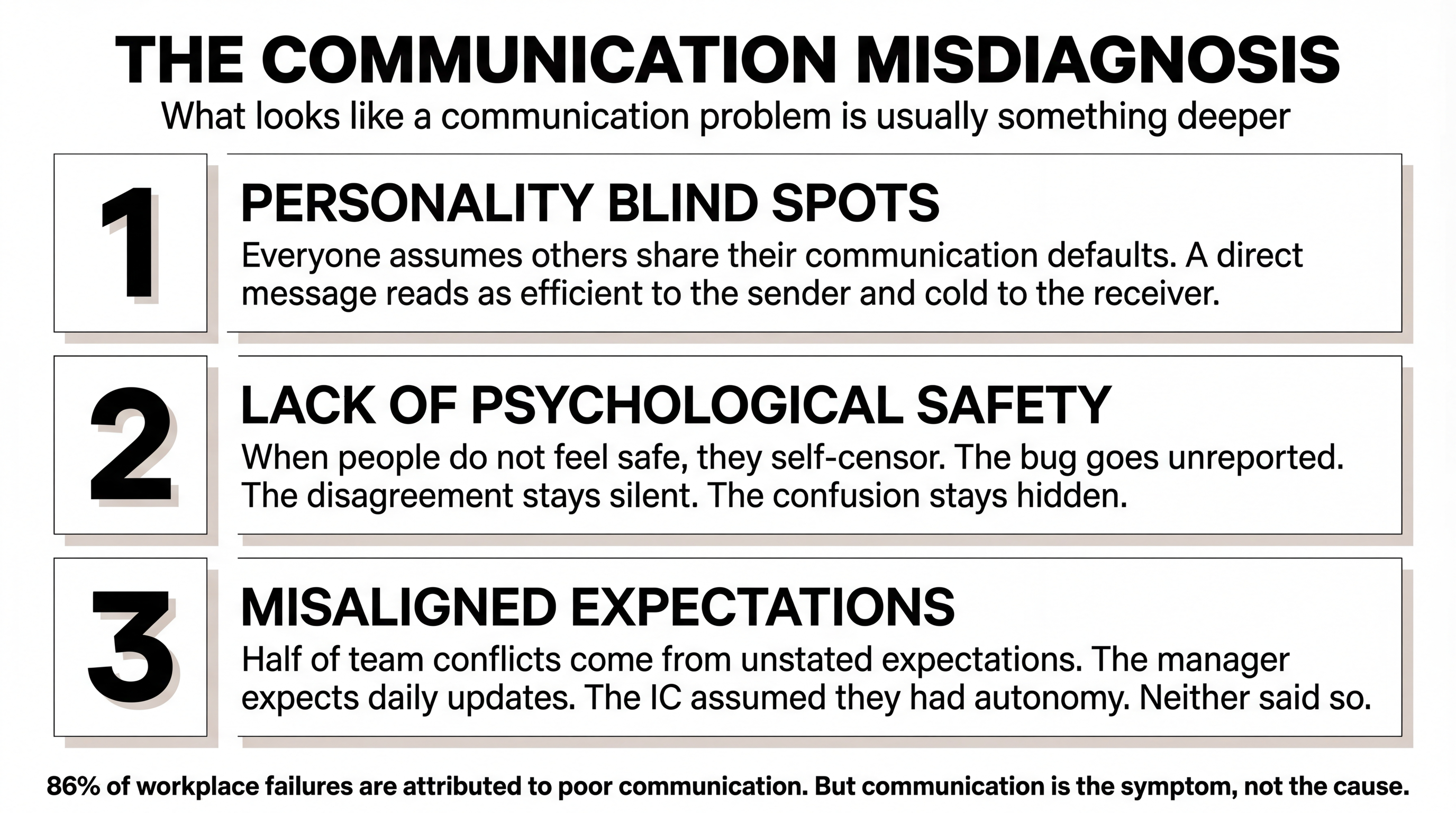
Root Cause 1: Personality blind spots. Every person on your team has a default communication style, and they assume everyone else shares it. A direct communicator sends a two-line Slack message and thinks they're being efficient. The recipient, who values warmth and context, reads it as cold and dismissive. Neither person did anything wrong. They're just operating with different defaults and no way to bridge the gap.
This plays out constantly. The analytical team member who needs data before making a decision gets frustrated by the colleague who decides based on intuition. The person who processes by talking out loud overwhelms the one who needs silence to think. These aren't personality flaws. They're personality differences, and most teams have zero language for navigating them.
Root Cause 2: Lack of psychological safety. Google's Project Aristotle studied hundreds of teams and found that psychological safety was the single most important predictor of team effectiveness. Teams with high psychological safety were rated as effective twice as often by management. They had lower turnover, generated more diverse ideas, and brought in more revenue.
When people don't feel safe, they self-censor. The junior engineer who spotted a bug doesn't mention it because last time they spoke up, they were shut down. The designer who disagrees with the direction stays quiet because the team lead gets defensive when challenged. The new hire who's confused by the process doesn't ask questions because they don't want to look incompetent. None of this is a "communication problem." It's a fear problem.
Root Cause 3: Misaligned expectations. Half the conflicts I've seen on teams boil down to one thing: people expected different things and never said so. The manager who expects daily progress updates gets frustrated when they don't receive them. The IC who assumed they had autonomy feels micromanaged when the updates are requested. Neither communicated their expectation because both assumed theirs was obvious.
This gets worse with remote and hybrid teams. When you're not in the same room, you lose the ambient context that fills in the gaps: body language, overheard conversations, the general energy of the office. Without that, every unstated expectation becomes a potential conflict.
Why Communication Training Fails
Most communication training addresses technique. How to structure a message. How to give feedback using the SBI framework. How to run a better meeting. These are useful skills. But teaching them without addressing the underlying causes is like teaching someone to drive on a road full of potholes. The driving lessons help, but the real problem is the road.
A team where people don't feel safe to speak honestly isn't going to fix that problem with better meeting agendas. A team where two people have completely different communication defaults isn't going to resolve that mismatch with a "Slack best practices" document. And a team where expectations live inside people's heads instead of on paper isn't going to align by scheduling more syncs.
The training fails because it assumes the infrastructure is sound and the technique just needs polishing. In reality, the infrastructure is what needs rebuilding.
What Actually Fixes It
The fix isn't more communication. It's more context. Specifically, three kinds.
Self-context. People need to understand their own communication patterns before they can adjust them. This is where personality assessments like DISC and MBTI earn their keep. Not as labels, but as mirrors. When someone realizes they default to directness under stress, they can flag that for their team instead of leaving them to interpret it as hostility.
Team-context. Once individuals understand themselves, the team needs a shared vocabulary for differences. This is where Personal User Guides become powerful. When everyone on the team has a PUG that explains their communication preferences, stress signals, and feedback needs, the translation work happens before the conflict, not after.
Structural context. Teams need explicit agreements about how they work. Not just "what" they're building, but "how" they build it. What response time is expected on Slack? When is an email better than a message? How do we make decisions when we disagree? These operating agreements sound mundane, but their absence is responsible for a huge percentage of team friction.
The Personality-Aware Team
The teams that communicate best aren't the ones with the most training hours. They're the ones with the most awareness. They know that their project lead processes by talking, so they don't mistake brainstorming for decision-making. They know their designer needs a day to sit with feedback before discussing it, so they don't schedule the review conversation the same afternoon. They know their engineering lead gets quiet when overwhelmed, so silence in a meeting doesn't get read as agreement.
This kind of awareness doesn't happen by accident. It requires intentional tools: assessments that reveal patterns, guides that make those patterns actionable, and a culture that treats personality differences as design constraints rather than personal failings.
Amy Edmondson, the Harvard professor who coined the term "psychological safety," framed it as "a shared belief that the team is safe for interpersonal risk-taking." That's a belief. And beliefs are built through consistent behavior over time: leaders who model vulnerability, teams that normalize questions, and systems that make it easier to understand each other than to misunderstand.
Stop Fixing the Symptom
Your team's communication problem is real. The friction is real. The misaligned expectations, the misread tones, the avoidable conflicts: all real. But the solution isn't better communication. It's deeper understanding.
Build a team where people know how their colleagues think, react, and prefer to work. Build a team where speaking up feels safe, not risky. Build a team where expectations are explicit, not assumed.
Do that, and the communication fixes itself. Or more accurately, the need for "fixing" communication disappears, because the conditions that created the problem no longer exist.
References
- Lencioni, Patrick. The Five Dysfunctions of a Team. Jossey-Bass, 2002. https://www.wiley.com/en-us/The+Five+Dysfunctions+of+a+Team%3A+A+Leadership+Fable%2C+20th+Anniversary+Edition-p-9781119600459
- Edmondson, Amy. The Fearless Organization. Wiley, 2018. https://www.wiley.com/en-us/The+Fearless+Organization%3A+Creating+Psychological+Safety+in+the+Workplace+for+Learning%2C+Innovation%2C+and+Growth-p-9781119477242
- Google. "Understand team effectiveness." re:Work. https://rework.withgoogle.com/en/guides/understanding-team-effectiveness
- Fierce, Inc. "86 Percent of Employees Cite Lack of Collaboration for Workplace Failures." 2011. https://www.fierceinc.com/wp-content/uploads/2020/06/PR___2011_Workplace_Collaboration_Survey___Fierce_Inc__.pdf
- Grammarly Business and The Harris Poll. "The 2024 State of Business Communication Report: What You Need to Know." https://www.grammarly.com/business/learn/introducing-2024-state-of-business-communication/